
What Is MOQ in Security Camera Sourcing and How Is It Calculated (2026)
Why a security camera MOQ exists, the three fixed costs behind the number, how to calculate a break-even quantity, and the five questions that move an MOQ down.
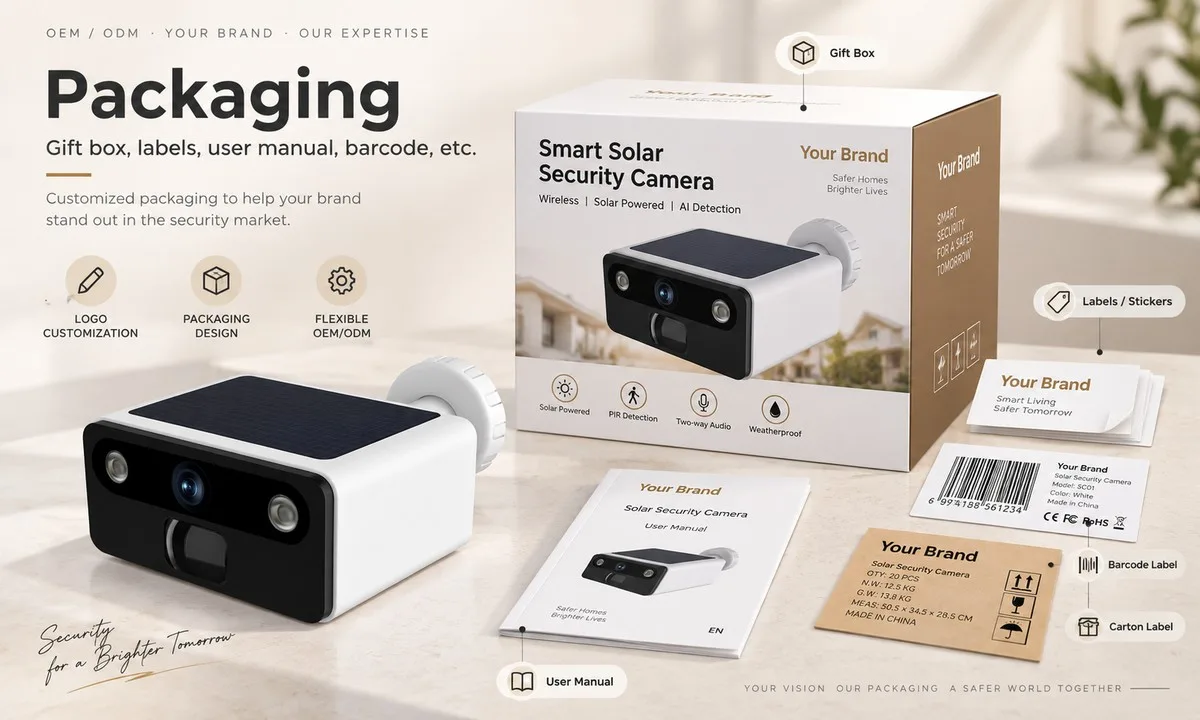
Key Points for Buyers
- MOQ is a break-even point, not a bargaining position
- Three fixed costs: changeover, packaging print run, per-SKU certification
- Break-even = total fixed cost divided by per-unit contribution
- What you change decides the floor: colour is cheap, radio is expensive
- Ask what moves the number down, not what the minimum is
- MOQ is a break-even point, not a bargaining position. It is the quantity at which three fixed costs stop losing money.
- The three costs are changeover, packaging and per-SKU certification. Only one of them scales with the product; the other two are print runs and line setup.
- Configuration, not brand, sets the number. A configuration already running on the line has a far lower entry point than a new one.
- You can calculate your own break-even MOQ from tooling, firmware and certification cost divided by the per-unit premium you avoid.
- Ask what moves the number down, not what the minimum is. The five levers below are worth more than a discount.
"What is your MOQ" is the first question most importers ask and the least useful one, because the answer is a single number without context. A factory that says 500 might mean 500 of an existing configuration, or 500 of a product that does not exist yet and needs tooling. The number only means something when you know what it is amortising.
This guide explains what the minimum order quantity is actually covering, how to calculate the break-even point yourself, and the five levers that move the number down without a price fight.
1. What MOQ is really pricing
A custom security camera order carries fixed costs that do not change with quantity. Below a certain volume those costs cannot be recovered from the unit price, so the factory sets a floor.
| Fixed cost | What it covers | Scales with quantity? | Typical driver |
|---|---|---|---|
| Line changeover / SMT setup | Loading the line for a specific board, programming placement machines, first-article inspection | No — same whether 200 or 2,000 units | Board complexity and number of placements |
| Packaging print run | Custom boxes, inserts, manuals, labels | Partly — printer has its own minimum | Print method (offset vs digital) and box structure |
| Certification and test reports | Radio, EMC, safety testing per SKU and market | No — one report per configuration | Number of markets and whether the radio changed |
| Firmware / app configuration | App name, UI language, feature flags, default settings | Mostly no | Whether the platform already supports the change |
| Tooling / moulds (OEM only) | Enclosure and structural parts | No | Whether the mould is new or shared |
Table 1 — Only packaging partly scales with volume. Everything else is a one-off that has to be divided across the minimum quantity.

2. A worked calculation
Take a private-label WiFi camera where the buyer wants a new enclosure colour, custom packaging and a new app name, sold into one market.
| Cost item | Assumption | Amount |
|---|---|---|
| Packaging plate / print setup | One-off | USD 600 |
| Firmware branding + UI | One-off engineering | USD 400 |
| Certification re-test (radio unchanged, label changed) | One-off | USD 1,200 |
| Line changeover allocation | Absorbed per run | USD 300 |
| Total fixed | USD 2,500 |
Table 2 — Illustrative figures; your market, lab and packaging choice will change them.
If the per-unit contribution on this SKU is USD 5, the break-even quantity is 2,500 ÷ 5 = 500 units. That is where the MOQ comes from. It is not a wish to sell more; it is the point at which the order stops losing money on setup.
3. Why the same factory quotes different numbers
| Situation | Typical effect on MOQ | Why |
|---|---|---|
| Configuration already in production | Lowest entry point | Setup cost already recovered by other buyers |
| Colour or packaging change only | Low to medium | No re-test if the radio and board are unchanged |
| New battery capacity or panel | Medium to high | Power behaviour changes; may require re-testing |
| New radio module or band | High | New radio certification, new test report |
| New enclosure tooling | Highest | Mould cost is amortised across the first order |
Table 3 — What you change decides the floor, more than how many units you want.
4. Five levers that move MOQ down
- Start from a shipping configuration. Colour, packaging and app name changes usually avoid re-testing. A new radio does not.
- Split the order by colour rather than by model. Colour variants share the board, the certificate and the test report, so the fixed cost is paid once.
- Use stock packaging for the trial run. Print the custom boxes for the second order, once sell-through is proven.
- Combine markets that share one radio. One SKU covering two countries with the same band needs one report, not two.
- Take a mixed first container. MOQ is normally per configuration, not per container, so several low-volume SKUs can travel together — confirm this in writing.
5. What MOQ does not include
Three things sit outside the minimum quantity and are worth agreeing at the same time, because they cause more disputes than the MOQ itself.
- Per-colour minimums. A 500-unit order split across four colours may still hit a 150-unit floor per colour, because packaging is printed per variant.
- Sample and trial quantities. Samples are usually outside MOQ, but a trial order of 50 units is normally priced as a sample run, not as a discounted production run.
- Spare parts and service packs. Batteries, brackets and adapters often have their own minimums, and they are the items you will need most in year two.
6. Questions that get a useful answer
| Instead of asking | Ask | What you learn |
|---|---|---|
| "What is your MOQ?" | "What is the MOQ for this configuration as it ships today, and what changes if I only change the packaging?" | Whether the fixed cost is setup or certification |
| "Can you do 200?" | "Which fixed costs would still be unrecovered at 200, and what would they add per unit?" | The real cost of a small order, in numbers |
| "Is there a discount at 1,000?" | "How does the per-unit price break down between material, labour, fixed cost recovery and margin?" | Where the negotiation room actually is |
| "How fast can you ship?" | "Which stage in your process most often delays a first order of this configuration?" | Honest lead-time risk |
Table 4 — The MOQ conversation goes better when it is about cost recovery rather than volume.
Frequently asked questions
Why is there an MOQ at all for a product the factory already makes?
Because your order still triggers a changeover, a print run and possibly a new label or certificate. The factory amortises those across a minimum quantity so the run is not loss-making. On a configuration that already ships, the minimum is much lower because most of that setup is already paid for.
Can MOQ be negotiated down?
Usually by changing what you ask for, not by pushing on price. Removing a re-test, using stock packaging for the first run, or accepting a shared colour all lower the fixed cost — and therefore the floor. Asking for a lower number without changing the cost structure just moves the cost into the unit price.
Is MOQ per order or per SKU?
Normally per configuration. Two colours of the same board and certificate often count together; two different radio modules usually do not. Get this in writing before you build a mixed order.
How does MOQ differ between white label, ODM and OEM?
White label has the lowest floor because nothing new is created. ODM sits in the middle and depends on whether your change touches the radio or the battery. OEM has the highest floor because tooling and new certification have to be amortised across the first order.
What happens if I order below MOQ?
Factories usually accept it as a sample or trial run at a higher unit price, or decline it. What they rarely do is absorb the setup cost — it reappears somewhere, either in the unit price, in the lead time, or in a later order.
Want your break-even MOQ, not a number?
Tell us the configuration you have in mind and the market you sell into. We will return the fixed-cost lines, the minimum for that configuration, and what each change would add.
Get the cost breakdown →Related reading: OEM vs ODM vs white label · Certification guide · Battery vs solar vs wired · OEM / ODM services · Buyer FAQ