
PIR vs AOV Detection in Solar Cameras: Blind Spots, Power and Data Cost (2026)
How PIR-triggered and AOV always-on detection differ in blind-spot coverage, idle power draw and cellular data cost — and how to choose per site instead of per price.
Key Points for Buyers
- PIR sleeps and wakes on heat; the first 1-3 seconds are often missing
- AOV keeps a low frame-rate record and switches up on detection
- AOV raises the constant power baseline, so panel and battery must be sized for it
- On cellular, continuous upload becomes a monthly cost the end user notices
- Choose per site: retail tolerates a missed second, evidence-sensitive sites do not
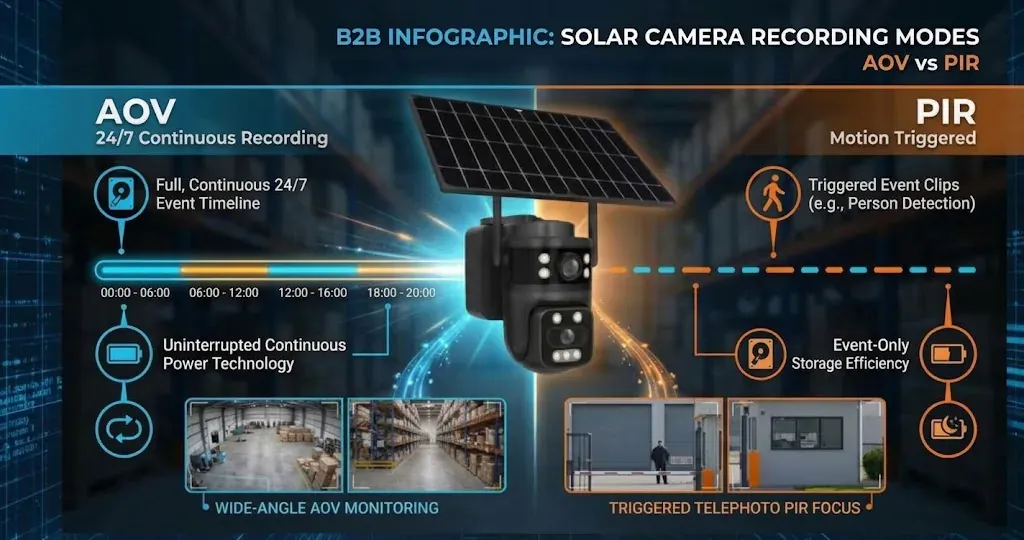
- PIR sleeps and wakes on heat. Lowest idle draw, but the first seconds of an event are often missing.
- AOV records continuously at a low frame rate and switches up on detection. It closes the gaps and costs power plus data.
- The gap is not theoretical. For a fence-line or a driveway, the missing two seconds is exactly the part that identifies the person.
- Data cost is the hidden line. Continuous pre-recording on a cellular plan changes the monthly bill, and the end user pays it.
- Choose per site, not per price. Retail tolerates a missed second; evidence-sensitive sites do not.
Most solar camera comparisons stop at the panel and the battery. The detection method decides something more expensive: whether the recording you get is usable as evidence, and what the end user pays every month for the privilege.
This guide explains how each method actually works, where each one loses the event, what the power and data differences look like in practice, and how to choose per installation site rather than per unit price.
1. What each method actually does
| Behaviour | PIR-triggered | AOV (Always-On Video) |
|---|---|---|
| Idle state | Deep sleep; the radio and sensor are mostly off | Continuous low frame-rate recording (typically a few frames per second) |
| Wake condition | Infrared heat change inside the detection zone | On-device human/vehicle classification, or scheduled switch |
| Recording before the trigger | None — recording starts after wake | Already recording, so the approach is captured |
| Recording after the trigger | Full frame rate until the clip ends | Switches to full frame rate, then falls back |
| Typical miss | The first 1–3 seconds, plus anything outside the PIR cone | Little to none within the field of view |
| Power profile | Lowest idle, short peaks | Higher constant baseline |
| Data profile | Event clips only | Continuous upload or larger local storage |
Table 1 — The trade is completeness against continuous power and data consumption.
2. Where PIR loses the event
Three mechanisms cause the familiar "the clip starts too late" complaint, and they compound:
- Wake latency. From heat trigger to first encoded frame there is a delay — sensor settle, encoder start, sometimes a network check. On a battery camera this is measured in fractions of a second to a couple of seconds depending on the design.
- The cone, not the scene. A PIR sensor covers a shape, not the camera's field of view. Someone entering at the edge of the lens can be inside the picture but outside the trigger zone for a second or two.
- Heat, not presence. A person in heavy clothing on a cold day, or someone approaching behind glass, produces a weaker signal. Detection distance quoted in a datasheet is a best case at a stated temperature difference.
3. The power arithmetic
AOV's cost is a constant baseline. On a solar camera the baseline has to be covered by the panel every day, in the worst month, not the best.
| Mode | What draws current | Effect on panel sizing | Effect on battery reserve |
|---|---|---|---|
| PIR only | Sleep current plus short event peaks | Smallest panel can work | Reserve mostly consumed by cloudy days, not by recording |
| PIR with pre-record buffer | Short cyclic buffer held in RAM | Slightly larger | Modest increase |
| AOV low frame rate | Sensor and encoder running continuously | Needs a genuinely larger panel and reserve | Reserve shrinks faster in low-light months |
Table 2 — AOV is not a firmware toggle you add to a PIR-sized power budget.
The practical consequence for a distributor: an AOV model in a rainy market needs to be specified as its own power system — panel, battery and mount — not ordered as the same unit with a different setting. Ask the factory for the idle current in AOV mode and the daily energy figure they used for panel sizing, then check it against the worst month in your market.
4. The data bill nobody quotes
| Item | PIR | AOV |
|---|---|---|
| Upload volume | Event clips only | Continuous stream, or event clips plus a larger local buffer |
| SIM plan pressure | Low — a modest monthly allowance is usually enough | Higher — the plan becomes a recurring cost the end user notices |
| Failure mode if the plan runs out | Fewer clips uploaded; local recording continues | Continuous upload stops; depends on local storage design |
| Who notices | The installer, rarely the end user | The end user, every month |
Table 3 — On cellular, AOV turns a hardware sale into a subscription conversation.
That last row matters commercially. In markets where prepaid data is expensive, an AOV camera sold without a realistic data allowance becomes a support call in month two. Either bundle a plan that fits, or design the deployment so continuous recording stays on the card and only events are uploaded.
5. The middle paths
The choice is not binary. Three configurations sit between pure PIR and full AOV, and they are often the right answer:
- PIR with a pre-record buffer. The camera keeps a short rolling buffer in memory while sleeping and writes the seconds before the trigger. Cheap in power, fixes most of the "starts too late" complaint.
- PIR for detection, low-rate continuous for context. A low frame-rate stream for the general timeline plus full-rate event clips.
- Hybrid by schedule. Full-rate continuous during business hours or at night, PIR the rest of the time — useful where the site has predictable risk windows.
6. Choosing per site
| Site | Recommended | Why |
|---|---|---|
| Residential driveway, one car | PIR with pre-record buffer | Complete enough, smallest panel, no data bill |
| Retail entrance, DIY channel | PIR | Buyer wants alerts, not a full timeline |
| Construction site perimeter | AOV | Theft attempts start before the trigger; evidence value is high |
| Farm gate, remote | AOV with strict data design | No one is on site; the recording is the only witness |
| Warehouse yard, cellular | AOV local, events uploaded | Continuous record on card avoids the monthly data bill |
| Battery-only site with no panel | PIR | AOV baseline would flatten the pack |
Table 4 — Match the method to what the site needs to prove, not to what the datasheet highlights.
7. What to verify on a sample
- Trigger-to-frame latency. Time the gap at day and at night, entering from the frame edge.
- Pre-record. If the model claims a buffer, confirm the clip actually contains footage from before the trigger.
- Classification accuracy. Walk a person and drive a vehicle past at the stated range; count false positives across ten passes.
- AOV idle current. Measure in AOV mode, not in PIR mode — the datasheet number is often the PIR one.
- Data behaviour. With a limited SIM, confirm the camera degrades gracefully instead of dropping the stream entirely.
Frequently asked questions
Is AOV just a marketing name for continuous recording?
Broadly yes, but the useful part is the switch: it records at a low frame rate to conserve power and jumps to full rate when a person or vehicle is detected. Plain continuous recording at full rate would flatten a solar battery quickly.
Can a PIR camera be upgraded to AOV with firmware?
Usually not. AOV raises the constant power draw, which changes panel and battery sizing. A unit designed around PIR idle current will not sustain AOV through a cloudy week even if the firmware allows it.
Which uses more cellular data?
AOV, by a wide margin if it uploads continuously. The workable design in expensive-data markets is continuous recording on the local card with only events uploaded.
Why does my PIR clip start after the person has already walked in?
Wake latency plus the difference between the PIR cone and the camera's field of view. A pre-record buffer fixes most of it; a wider PIR arrangement fixes the rest.
What should I ask the factory before ordering an AOV model?
Three numbers: idle current in AOV mode, the daily recording hours assumed in panel sizing, and the upload policy when the SIM allowance runs out. A supplier who cannot answer all three is quoting a specification they have not tested.
Choosing between PIR and AOV for your market?
Tell us the site type and whether the deployment is cellular or WiFi. We will recommend the detection design, the panel and battery that can carry it, and the data policy that avoids a monthly complaint.
Discuss your deployment →Related reading: Solar camera buyer checklist · Battery vs solar vs wired · AOV cameras · All buying guides