
Security Camera Certifications for Importers: FCC, CE, RoHS, KC and NBTC Explained
A market-by-market guide to FCC, CE, RoHS, KC, NBTC and TELEC approval for security cameras: who signs the declaration, when re-testing is triggered, and how to verify a report covers your SKU.
Key Points for Buyers
- Certification follows the destination market, not the factory
- Wireless cameras need an FCC ID for the radio; digital circuitry uses a supplier declaration
- CE is a self-declaration supported by a technical file, signed by the entity placing it on the market
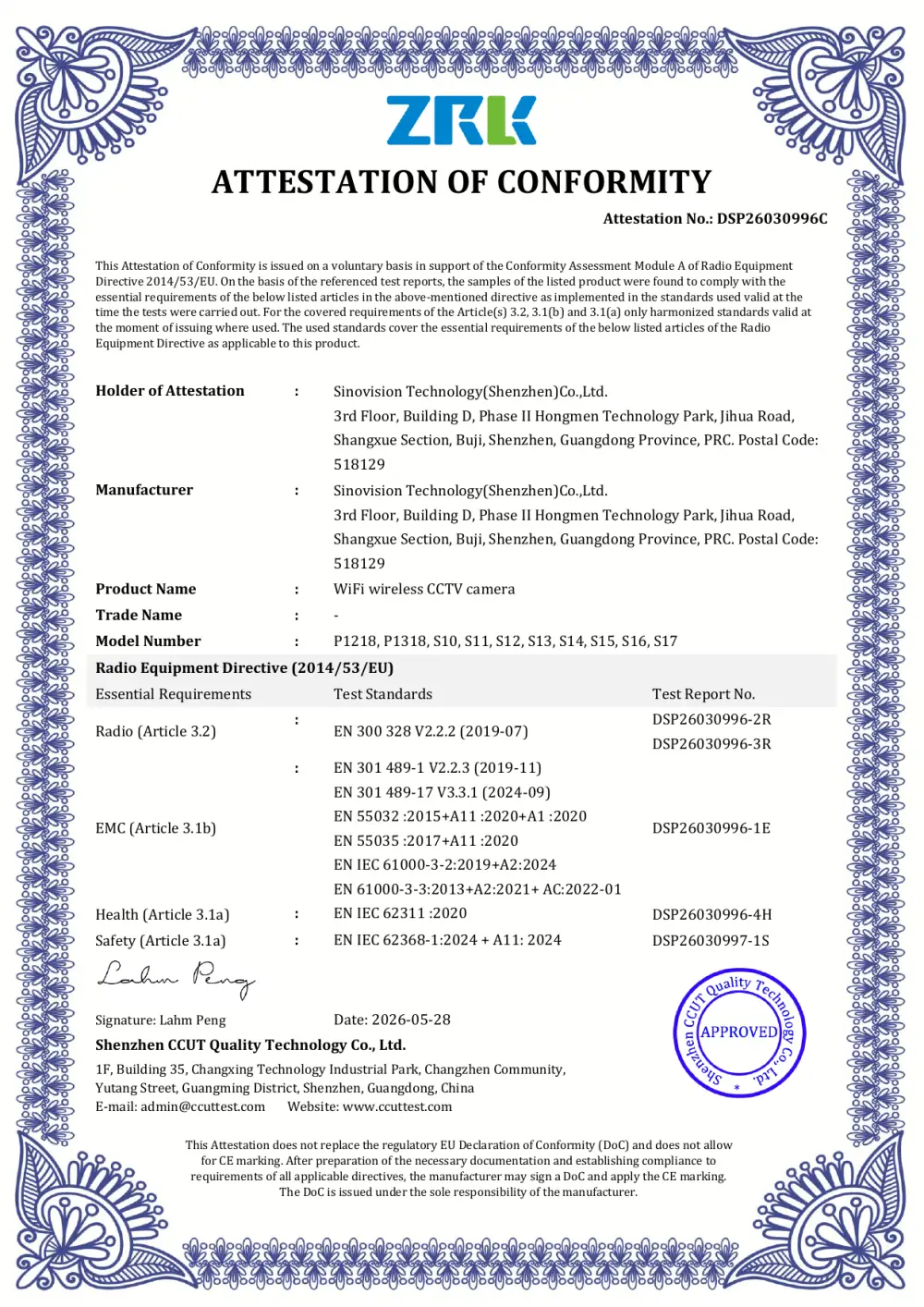
- Our CE-RED attestation DSP26030996C covers models P1218, P1318, S10-S17
- Our FCC grant DA2JN-SN-S3 covers the 2412-2462 MHz wireless security camera
- KC, NBTC and TELEC require a local applicant in country
- Certification follows the market, not the factory. One SKU sold into five countries can need five different approvals.
- Radio approval is per model, and often per radio version. Change the 4G band or the WiFi module and the report may no longer cover it.
- Who signs depends on the model. In white label and ODM the factory usually holds the reports; in full OEM the buyer is normally the responsible entity.
- Verify the document, not the claim. The model number on the report has to match the SKU you are buying.
- Battery products carry a second track. UN38.3 and transport documents sit alongside the market certificate.
Certification problems rarely appear at the sample stage. They appear when a container reaches customs, or when a marketplace asks for a certificate that names the wrong model. Both are avoidable with a twenty-minute document review before you approve production.
This guide covers what each market actually requires, who is legally responsible, and how to check that a test report covers your product rather than a similar one.
1. Which approval applies to which market
| Market | Framework | What a camera typically needs | Who normally applies |
|---|---|---|---|
| United States | FCC rules (47 CFR Part 15) | FCC ID for the radio (certification); supplier's declaration for digital circuitry | Factory holds it; buyer is the responsible party for the finished product |
| European Union | RED 2014/53/EU, EMC 2014/30/EU, RoHS 2011/65/EU | CE marking with an EU declaration of conformity and a technical file | Usually factory; importer keeps the declaration on file |
| United Kingdom | UKCA (CE recognition varies by rule set) | UKCA marking or accepted CE, depending on current rules | Importer or UK representative |
| South Korea | KC mark, RRA registration | Radio conformity registration or certification depending on the radio type | Local representative or importer |
| Thailand | NBTC type approval | Type approval or registration per NBTC class | Thai importer |
| Japan | Radio Law (TELEC / Giteki) | Technical conformity mark on the radio | Japanese importer or agent |
| Australia | RCM | Supplier's declaration plus EMC and radio compliance | Australian supplier or importer |
Table 1 — The market drives the framework. Confirm the destination list before the sample is finalised, not after.
2. United States: FCC
Two separate things are often collapsed into one word. For a wireless camera:
- Radio (intentional radiator): the WiFi, 4G or other radio requires an FCC ID, obtained through certification testing at an accredited lab and a Telecommunication Certification Body. The FCC ID belongs to the grantee named on it.
- Digital circuitry (unintentional radiator): covered by a Supplier's Declaration of Conformity, which the responsible party issues without a filing.
The practical question for an importer: does the FCC ID name the model you are buying? When a factory reuses a module approval across a family of products, the finished product may still need its own declaration, and the labelling has to match.
3. European Union: CE
CE is not a certificate issued by an authority. It is a self-declaration supported by evidence. For a camera, three directives usually apply:
| Directive | Covers | Evidence normally held |
|---|---|---|
| RED 2014/53/EU | Radio equipment: WiFi, 4G, and the product's radio behaviour | Test reports against harmonised standards, plus the EU declaration of conformity |
| EMC 2014/30/EU | Electromagnetic compatibility of the non-radio parts | Emissions and immunity test reports |
| RoHS 2011/65/EU | Restricted substances in electrical equipment | Material declarations or test reports from component suppliers |
Table 2 — Three directives, one CE mark. The technical file has to cover all of them.
Who is responsible: the manufacturer or the importer placing the product on the EU market. The declaration must name that entity and be kept available for market surveillance. This is why an OEM buyer is usually the signatory: the product carries the buyer's brand, so the buyer is the manufacturer of record.
4. RoHS: the quiet one
RoHS is where low-cost supply chains slip. The restriction covers ten substances, including lead, cadmium, mercury and specific phthalates. The point for importers is that RoHS evidence is component-level: it comes from suppliers of the PCB, solder, cable insulation and housing coating, not from a single product test.
Ask for the material declarations behind the claim, and note that a housing or battery change can reopen the file even when the electronics are unchanged.
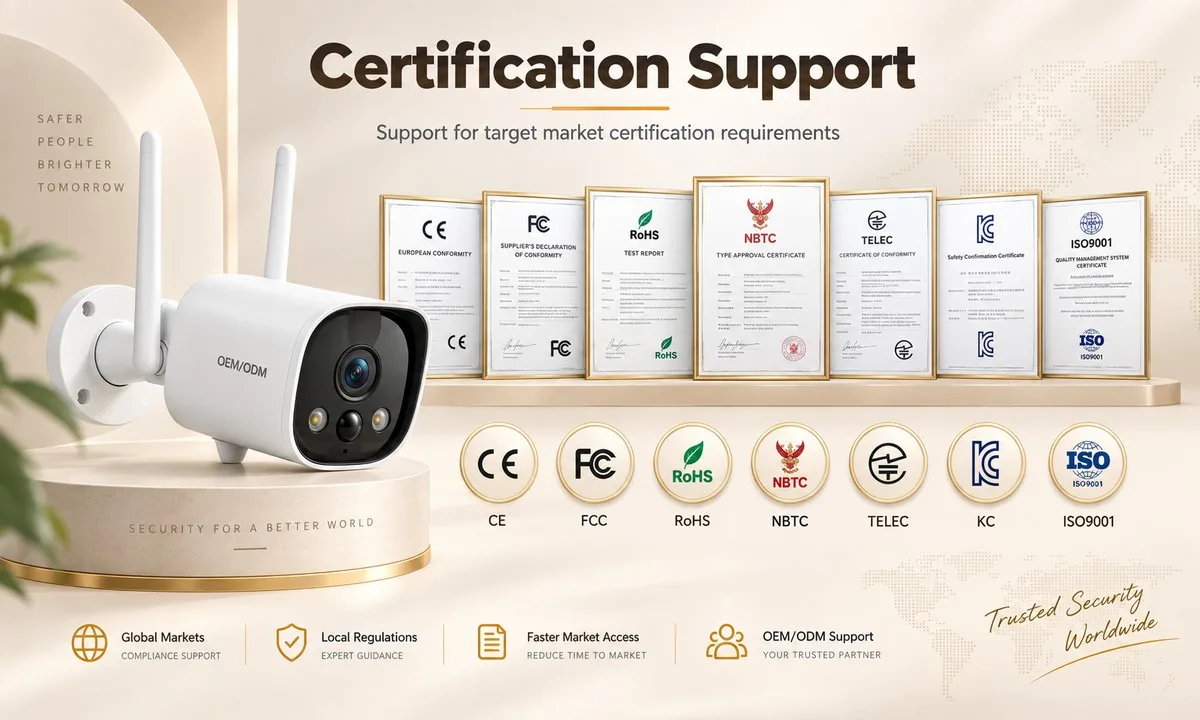
5. Korea (KC), Thailand (NBTC), Japan (TELEC)
These three share a pattern: the approval is tied to a local entity, which is why factories cannot simply hand you a certificate and walk away.
- KC (Korea): radio equipment is registered or certified with the National Radio Research Agency, and the KC mark is applied to the product. The application is normally made by a Korean representative or importer.
- NBTC (Thailand): type approval or registration depending on the equipment class, with the Thai importer named in the process. Unregistered radio equipment can be held at customs.
- TELEC (Japan): the Radio Law requires technical conformity certification for specified radio equipment, shown by the technical mark. A Japanese importer or agent is normally the applicant.
6. Who signs what: OEM vs ODM vs white label
| Situation | Who is the manufacturer of record | Who holds the report | Practical consequence |
|---|---|---|---|
| White label | Factory | Factory | Buyer references existing reports; check the model list covers the SKU |
| ODM with configuration changes | Factory (usually) | Factory, possibly re-tested | A band, battery or panel change may require re-testing |
| Full OEM, buyer's brand | Buyer | Buyer | Buyer pays for testing and signs the declaration of conformity |
Table 3 — The brand on the label decides the signature on the declaration.
SINOVISION supports CE, FCC, RoHS, KC, NBTC and TELEC documentation for the markets we ship to, and we tell buyers which items they must hold in their own name rather than pretending the factory can sign for them. If a certificate cannot be transferred, we say so before the order, not after.

7. Five checks that prove a report covers your product
- Model number match. The model on the report must match the SKU on your purchase order — not a family name, not a similar variant.
- Certificate holder. Identify the legal entity that holds it. If it is a module supplier, your finished product may not be covered.
- Standard version. Confirm the edition cited in the report is the one currently applied in that market.
- Radio configuration. Band, power and antenna arrangement should match what you are buying. A different antenna can invalidate a radio result.
- Lab accreditation. The test lab should be accredited for the test in question, and the report should show the accreditation reference.
8. Four traps that cost importers money
- Module approval treated as product approval. A certified radio module does not automatically certify the finished camera.
- Battery transport documents missing. Lithium cells need UN38.3 test summaries and transport documentation, separate from the market certificate.
- Re-testing forgotten after a change. New battery capacity, new panel or new radio band can push the product outside its original report.
- Declaration signed by the wrong entity. If the declaration names the factory but the label carries your brand, market surveillance will treat it as defective.
9. Certificate evidence: what we can show you today
Most supplier pages say "we have CE and FCC". A buyer cannot check a claim. Below are two documents from our own product files, with the certificate numbers visible so you can verify them independently before you place an order.
| Document | Number | Scope | Issuer / date |
|---|---|---|---|
| Attestation of Conformity (RED, Module A) | DSP26030996C | WiFi wireless CCTV camera: models P1218, P1318, S10–S17 | Shenzhen CCUT Quality Technology Co., Ltd · 28 May 2026 |
| Radio tests (Art. 3.2) | DSP26030996-2R / -3R | EN 300 328 V2.2.2; EN 301 489-1 V2.2.3; EN 301 489-17 V3.3.1 | same |
| EMC (Art. 3.1b) | DSP26030996-1E | EN 55032; EN 55035; EN IEC 61000-3-2; EN 61000-3-3 | same |
| Health / Safety (Art. 3.1a) | DSP26030996-4H / DSP26030997-1S | EN IEC 62311:2020; EN IEC 62368-1:2024+A11:2024 | same |
Table 4 — Test reports behind the CE-RED attestation, as listed on the document itself.
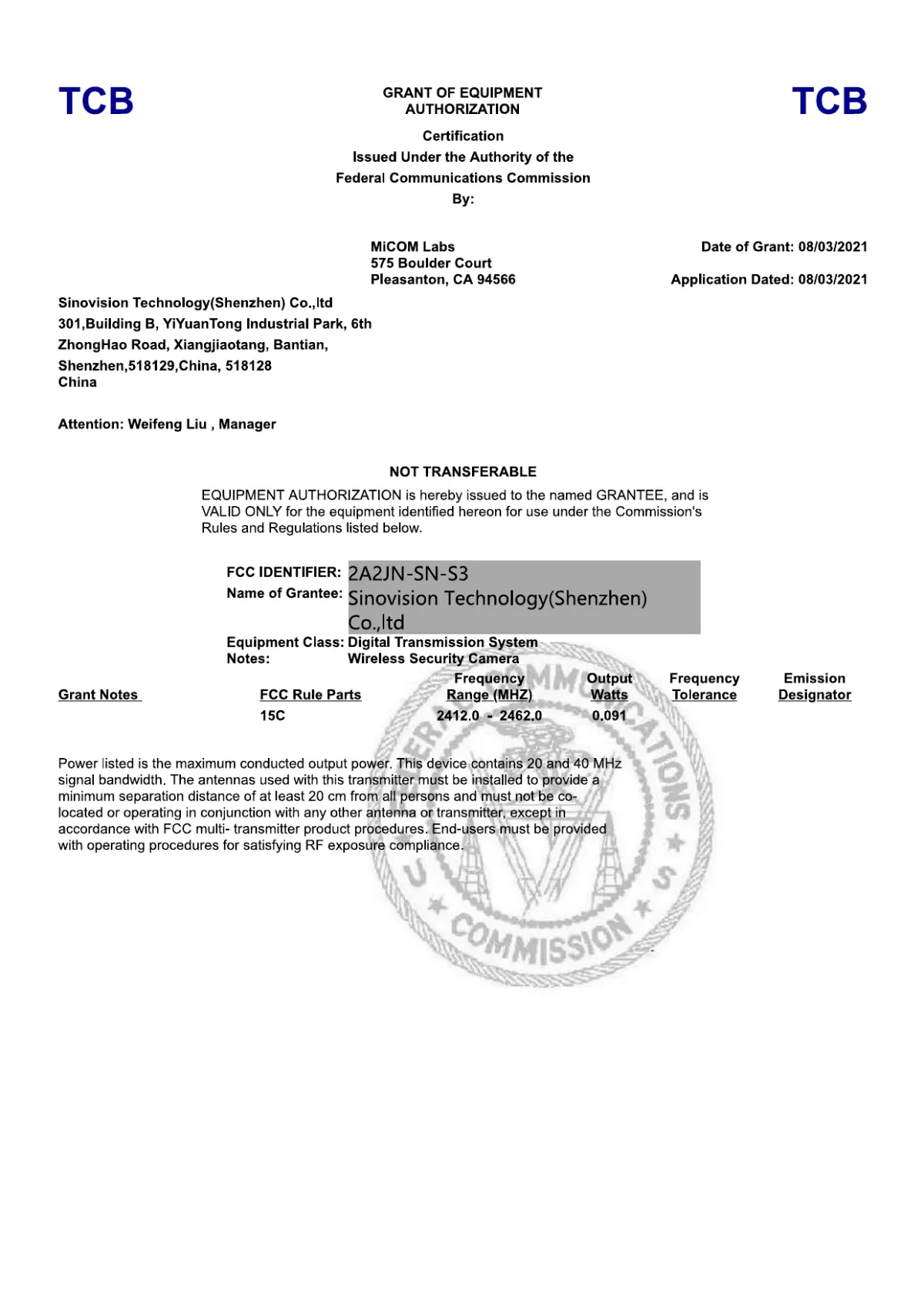
| Field | Value on the grant |
|---|---|
| FCC ID | DA2JN-SN-S3 |
| Grantee | Sinovision Technology (Shenzhen) Co., Ltd |
| Equipment class | Digital Transmission System — wireless security camera |
| Frequency / output | 2412.0–2462.0 MHz, 0.091 W maximum conducted |
| Rule part | 15C |
| Date of grant | 08 March 2021 |
| Notes | 20 MHz and 40 MHz bandwidth; 20 cm minimum separation; not transferable |
Table 5 — The fields an importer should reconcile against the purchase order.
Two things to notice, because they are the checks most buyers skip. First, the grant names one grantee and one equipment description: if your SKU uses a different radio module or antenna arrangement, this grant does not cover it, and our answer to you would be that the model needs its own filing. Second, the attestation covers specific model numbers — P1218, P1318 and S10 to S17. If the model you are quoted is not on that list, ask which document covers it.
If you want the source files rather than page images, ask for the PDFs by number. We send the attestation, the four test reports listed above, and the FCC grant as a single pack, so your compliance team can check the editions and the accreditation references themselves.
Frequently asked questions
Does a security camera need both FCC and CE?
Only if you sell into both markets. FCC applies to the United States and CE to the European Union; each is a separate framework with its own evidence. A product can hold both, and most OEM manufacturers test once and file into both systems.
Can a factory transfer its certificate to my brand?
Usually not. Certificates are held by a named entity. What transfers is the underlying test data, which you can use to support your own declaration — but if the brand and the responsible entity change, the declaration is normally reissued in your name.
How long does certification take?
It depends on the market, the lab queue and whether the product passes first time. Radio testing for a new model typically runs weeks rather than days, and market registration with a local authority adds its own timeline. Plan certification as a parallel track to tooling, not a step after production.
Is CE self-certification acceptable for cameras?
CE is a self-declaration for most camera products, but it must be supported by test reports and a technical file. Self-declaration is a process, not a shortcut: you are stating that the evidence exists and can be produced on request.
What happens if my product arrives without the right approval?
Customs can hold the shipment, marketplaces can delist the listing, and a competitor can report the product to market surveillance. In the EU, the importer carries the responsibility, which is why the document review belongs before production, not after arrival.
Need the certificate list for your target markets?
Tell us the countries you are shipping to and the models you are considering. We will return the approval matrix and say which documents you must hold in your own name.
Request the approval matrix →Related reading: OEM vs ODM vs white label security cameras · Solar camera buyer checklist · All buying guides · Buyer FAQ · OEM / ODM services