
White Label Security Camera Program: A Step-by-Step Launch Plan (2026)
How to launch a white label security camera range: what white label really includes, an eight-step plan with realistic timelines, launch SKU selection, packaging checklist and the failures that kill first orders.
Key Points for Buyers
- White label means the product exists already; you buy branding and packaging
- Launch with two or three SKUs, not eight
- Packaging artwork is the longest lead item and the usual delay
- Be honest about the app brand in listings and manuals
- Budget for support in month one, not just inventory
- White label means the product already exists. You buy it, brand the packaging, and lean on the factory's certificates.
- Launch with two or three SKUs, not eight. Depth beats breadth in the first container.
- Packaging is the longest lead item and the most common cause of a missed launch date.
- Be honest about the app. If the app carries the platform's brand, say so in the listing rather than implying otherwise.
- Budget for support, not just inventory. Every white label launch generates setup questions in month one.
White label is the fastest route from decision to first container, and the one most often botched — not because the product is wrong, but because the launch is planned backwards. Buyers pick eight SKUs to look like a real brand, print packaging for all of them, and then discover that two SKUs account for most of the sell-through while six sit in the warehouse.
This guide is the sequence we would follow: what white label includes, an eight-step plan with realistic timings, how to choose launch SKUs, and the failure points that sink first orders.
1. What white label actually includes
| Item | White label | ODM | OEM |
|---|---|---|---|
| Hardware design | Factory's existing product | Factory platform, your configuration | Your specification |
| Certificate holder | Factory | Usually factory | Usually buyer |
| Your logo on product | Printed or laser-etched | Yes, plus configuration | Yes, plus tooling |
| Packaging | Custom box, your artwork | Custom box and inserts | Full structural design |
| App | Shared platform app | Configurable UI, sometimes branded | Branded app possible |
| Tooling cost | None | Low to medium | High |
| Time to first container | Shortest | Short to medium | Longest |
Table 1 — White label buys speed and low fixed cost, and gives up exclusivity.
2. The eight-step launch plan
| # | Step | Duration | Output |
|---|---|---|---|
| 1 | Channel and price positioning | 1 week | Target channel, price band, competitor set |
| 2 | SKU shortlist from the factory catalogue | 3–5 days | 2–3 launch SKUs plus one spare candidate |
| 3 | Sample order and hands-on test | 5–7 working days + transit | Pairing, image, night IR, app experience notes |
| 4 | Commercial terms | 3–5 days | MOQ, price, incoterm, payment split, RMA terms |
| 5 | Brand assets and packaging artwork | 2–4 weeks | Print-ready files, plate approval |
| 6 | Packaging production | 7–15 days | Boxes and manuals at the factory |
| 7 | Production and aging | 20–30 days | Packed goods with test records |
| 8 | Listing content and support setup | Parallel to 5–7 | Product pages, FAQ, warranty wording, support inbox |
Table 2 — Steps 5 and 8 run in parallel. Sequential planning is why launches slip.
3. Choosing launch SKUs
Three rules, in order of importance:
- Start with what ships today. A configuration already in production has the lowest MOQ, the shortest lead time and no certification re-test.
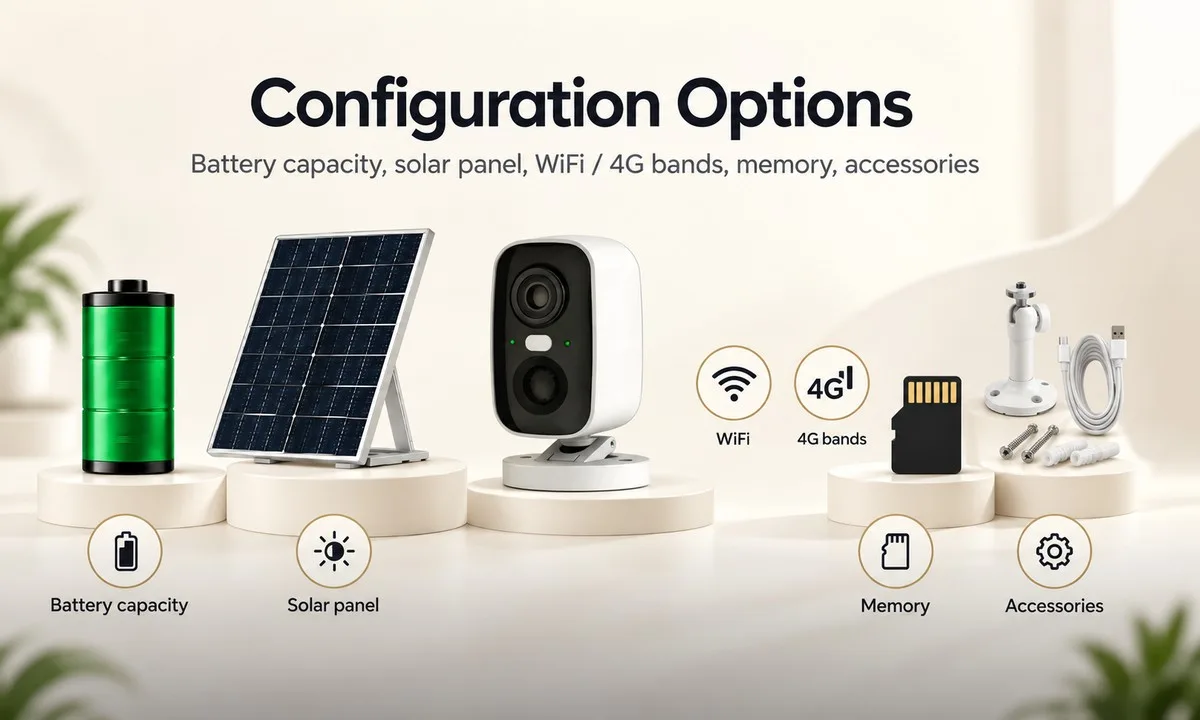
- Cover two architectures, not four. One battery WiFi SKU plus one 4G solar SKU covers self-install and off-grid demand with two accessory families.
- Keep one spare candidate unlaunched. Test it in the second order, when you know which of the first two turns faster.
| Channel | Launch SKU set | Why |
|---|---|---|
| E-commerce / retail | Battery WiFi indoor-outdoor, one hero SKU | Self-install, lowest return friction |
| Installer supply | PoE camera plus NVR kit | Installer sells reliability and bills labour |
| Agricultural / construction | 4G solar, one hero SKU | No power, no network at the site |
| Mixed distribution | One battery + one 4G solar | Two accessory families, two channels |
Table 3 — Match the launch set to how your buyer installs.
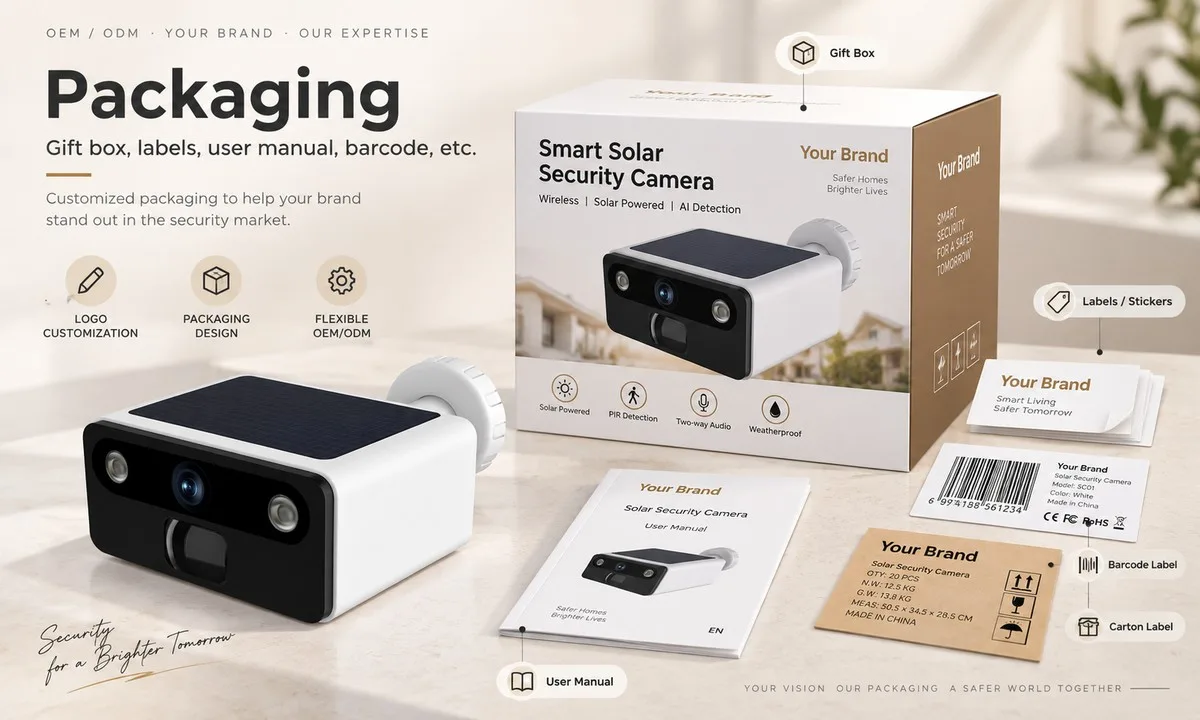
4. Packaging checklist
| Item | Why it matters | Common miss |
|---|---|---|
| Box artwork files | Print plates cannot start without them | Artwork sent as a low-resolution PDF |
| Dieline | Structural fit for the actual product | Reusing another model's dieline |
| Manual language set | Returns rise when setup steps are unclear | Machine translation without review |
| Label with model and certificate reference | Customs and marketplace checks | Label does not match the SKU |
| Barcodes | Retail and warehouse scanning | Wrong GS1 prefix or duplicate codes |
| Warranty card | Support boundary in writing | Promising terms the factory will not back |
Table 4 — Six items. Two of them (dieline, barcode) cause recalls from shelves rather than returns.
5. The app question, answered honestly
White label usually means the app keeps the platform's name. That is fine — as long as your listing, manual and support script say so. Buyers get upset when they discover an unfamiliar app name after purchase, not when they are told in advance.
If a branded app is a requirement for your channel, that moves the project from white label to ODM at minimum. Budget accordingly: branded app work, review cycles and store listings are a different timeline from packaging.
6. Five failures that sink first orders
- Eight SKUs, one container. Capital spread too thin to reorder the winner.
- Artwork approved late. The launch date moves; the vessel does not wait.
- No support script. Month-one questions go unanswered and become one-star reviews.
- Warranty promised beyond factory terms. You personally fund the gap.
- No certificate check. The model on the report does not match the SKU you branded.
Frequently asked questions
How long does it take to launch a white label camera range?
From decision to loaded container, plan on 8–12 weeks for an existing configuration: one to two weeks for sampling and terms, two to four weeks for packaging artwork and production, then 20–30 days of production. Custom packaging is what usually pushes it past 12 weeks.
What is the minimum order for white label?
It depends on the configuration and the packaging. An existing configuration with stock packaging has the lowest entry point; custom boxes add a print minimum that is often higher than buyers expect. Ask for the breakdown instead of a single number.
Can I put my own brand on the app with white label?
Usually not. White label keeps the platform app; branded apps normally require an ODM or OEM arrangement with app customisation. Check this before you print boxes, because the packaging copy often mentions the app.
Who holds the certificates in a white label program?
The factory. You reference their existing reports — which is why verifying the model number on the report matters. If your SKU is not on the list, the report does not cover it.
How do I differentiate if others sell the same hardware?
Through the parts a buyer experiences: packaging quality, manual clarity, support responsiveness, listing content, warranty handling and the channels you serve. That is a marketing and service game, not a product game — and it is the honest basis for a white label launch.
Planning a white label launch?
Tell us your channel and target launch date. We will shortlist configurations that ship today, quote the packaging minimum, and give you the milestone dates to work backwards from.
Plan the launch →Related reading: OEM vs ODM vs white label · Lead times explained · MOQ explained · OEM / ODM services · All buying guides