
How to Size a Solar Panel and Battery for a 4G Security Camera (2026)
A sizing method for 4G solar security cameras: build the daily energy budget from idle, event and IR draw, convert to panel watts with real sun hours, and set battery reserve for cloudy days.
Key Points for Buyers
- Size on daily watt-hours, not on panel labels
- Four draws: idle, event recording, night IR and cellular upload
- Panel W = daily Wh / (low-month sun hours x system efficiency)
- Battery reserve should be stated in days of autonomy, not mAh
- Cold derating and IR load are the two numbers buyers forget
- Size on energy, not on labels. "1.5W panel with 9000mAh battery" says nothing until you know the camera's daily watt-hours.
- Build the daily budget from four draws: idle, event recording, night IR and cellular upload.
- Convert to panel size with real sun hours in your worst month, and a system efficiency well below nameplate.
- Set battery reserve in days of autonomy, not in mAh — 2 to 4 cloudy days is the usual design target.
- Derate for cold. Lithium capacity and charging behaviour both get worse below 10°C, and winter is when solar margins vanish.
Most undersized solar cameras were not built badly. They were sized against a summer month, a datasheet power figure, or a battery capacity that looked generous in mAh. The camera then fails in the fourth cloudy day of winter, and the distributor receives a warranty claim that looks like a product fault but is an arithmetic problem.
This guide gives the sizing method we use before quoting a 4G solar configuration: build the daily energy budget, convert it into panel watts with realistic sun hours, then set battery reserve for the worst week of the year.
1. Build the daily energy budget
Four things draw current over a day. Ask the factory for each of them, because a single "power consumption" figure hides exactly the part that matters.
| Draw | When it happens | What to ask |
|---|---|---|
| Idle / standby | All day, including sleep mode | Sleep current in mA, and whether the radio stays registered |
| Event recording | Each wake-up: sensor, encoder, write | Current during a clip, plus average clip length and events per day |
| Night IR | Every event after dark, or continuously in AOV | IR LED current and how it scales with the number of LEDs |
| Cellular upload | Per event, or continuous in AOV | Radio transmit current and the upload seconds per clip |
Table 1 — Four draws, four questions. A consolidated "consumption" number cannot be used for sizing.
2. A worked example
Assumptions are listed so you can replace them with your own factory numbers. This is a 3.6 V battery camera, 20 events per day, half of them at night.
| Item | Assumption | Daily Wh |
|---|---|---|
| Idle (sleep, radio registered) | 3 mA for 24 h | 0.26 |
| Event recording | 120 mA for 20 s × 20 events | 0.48 |
| Night IR | 250 mA for 20 s × 10 night events | 0.50 |
| Cellular upload | 180 mA for 10 s × 20 events | 0.36 |
| Total per day | 1.60 Wh |
Table 2 — Illustrative figures only. Your numbers depend on the module, the clip length and the network.
Notice how the idle draw is the smallest line. On a camera that records thirty clips a day at night, the IR and radio lines dominate — which is why "the camera only draws 3 mA" is not an answer to a sizing question.
3. Convert to panel watts
A panel's nameplate wattage is measured at standard test conditions that a mounted camera rarely sees. Use the lowest monthly sun hours for your market, and apply a system efficiency that accounts for heat, angle, shading and charging losses.
| Region (typical) | Low-month peak sun hours | Effect on panel size |
|---|---|---|
| Northern Europe / UK | ≈ 1.5–2.5 h | Needs the largest panel per Wh; winter is the binding constraint |
| Central / Southern Europe | ≈ 2.5–4.5 h | Moderate; December–January still weak |
| Middle East / North Africa | ≈ 4.5–6.5 h | Smaller panel, but heat derating matters |
| Southeast Asia | ≈ 3.5–5 h, monsoon dip | Size on the monsoon months, not the annual average |
| North America (mixed) | ≈ 2–5 h depending on latitude | Coastal fog and northern winters drive the number |
Table 3 — Approximate ranges for orientation only; take the figure for your specific city and month.
4. Size the battery by days of autonomy
Battery capacity is a buffer for consecutive bad days. Express it in days of autonomy — how long the camera runs with no solar input at all — not in mAh.
Sixteen days sounds generous, and at this event rate it is. Double the events, add AOV, or drop to 0°C, and the same pack covers far fewer days. That is why the honest way to quote a solar camera is "X events per day and Y days of autonomy", not a single standby figure.
5. Five mistakes that produce warranty claims
- Sizing on the annual average. The camera has to survive the worst month, not the mean.
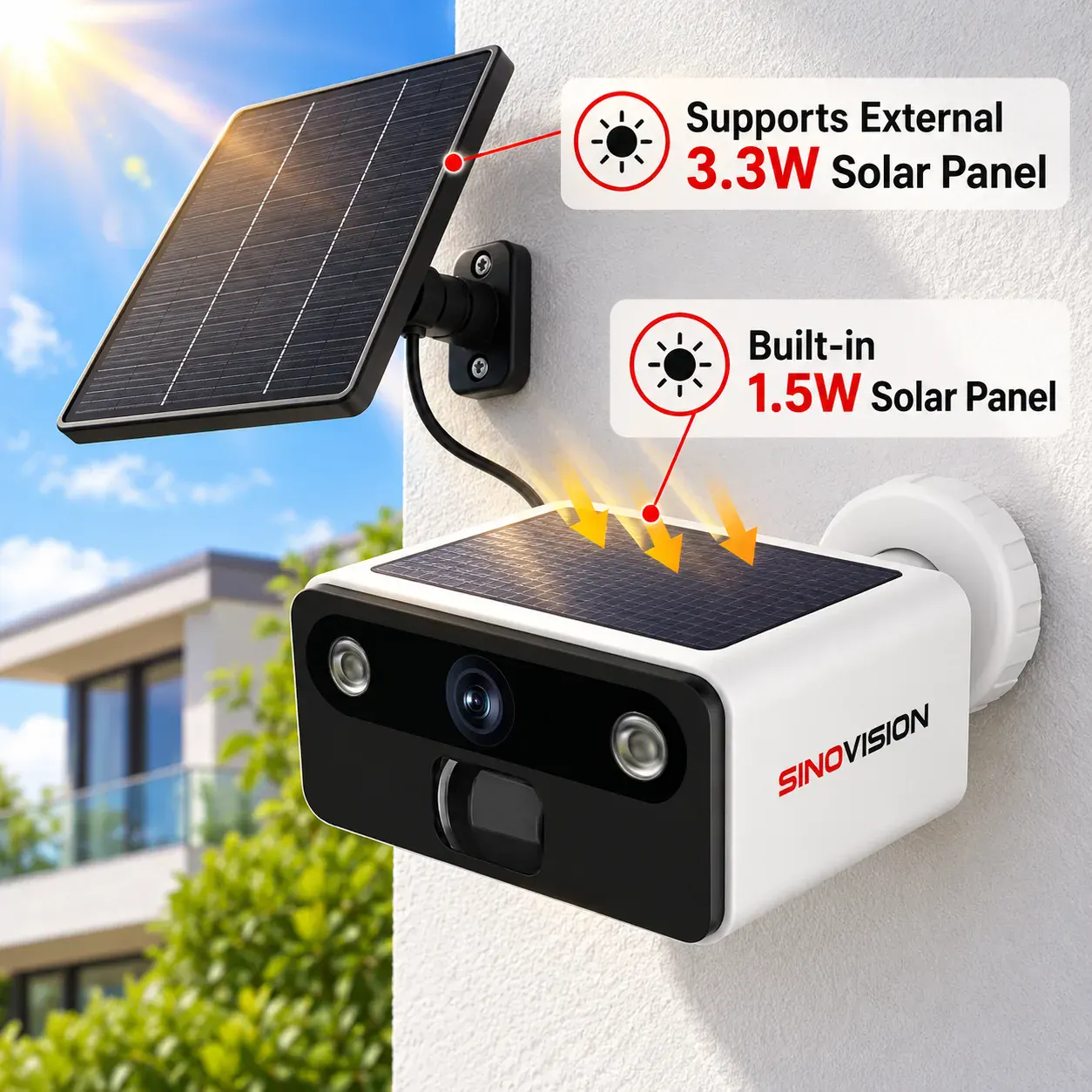
- Using nameplate watts. A 3.3 W panel in a shaded mount at a bad angle delivers a fraction of that.
- Ignoring IR and radio. Night events and cellular upload are the largest lines at typical duty cycles.
- Forgetting cold derating. Around and below freezing, usable capacity falls and charging must be restricted to protect the cells.
- Quoting mAh instead of autonomy. mAh without voltage, duty cycle and depth of discharge is not a runtime.
6. What to ask a supplier before you commit
| Question | Why it matters |
|---|---|
| Idle current with the radio registered, mA | The baseline that runs 24 hours a day |
| Event current and typical clip length | Converts events into watt-hours |
| IR current, and whether it scales with LED count | The dominant night draw |
| Assumed events per day for your quoted panel/battery | The specification behind the marketing number |
| Low-voltage cut-off and low-temperature charge limit | Protects the pack, but reduces usable capacity in winter |
| Panel cable length supplied | Short cable forces a shaded mount into full sun |
Table 4 — A supplier who can answer all six is sizing by calculation; one who cannot is sizing by feel.
Frequently asked questions
Is a 3.3 W panel always better than 1.5 W?
Not automatically better, but it gives more headroom — and headroom is what a cloudy week consumes. In a low-sun market or a shaded mount, the larger panel is usually the difference between working and not working.
How many cloudy days should a solar camera survive?
Design for 2 to 4 days of autonomy at your stated event rate. Longer autonomy means a bigger pack, which means more cost and more cold-weather management.
Why does my camera last two weeks in summer and four days in winter?
Three effects stack: fewer sun hours, lower panel output at a poor angle, and reduced battery capacity in the cold. Winter sizing is the correct sizing.
Does 18000mAh actually double the runtime over 9000mAh?
At the same voltage and depth of discharge, roughly yes — but only if the panel can refill it. A bigger battery with an undersized panel just takes longer to recover.
Can I add an external panel to an integrated-panel model?
Only if that model was designed with an external input and the charging circuit accepts the higher current. Ask for the input specification rather than assuming the connector means support.
Want the sizing done for your market?
Send us your target country, monthly event estimate and whether the site is shaded. We will return a panel and battery configuration with the assumptions stated, so your installer can check it.
Request a sizing sheet →Related reading: PIR vs AOV detection · Solar camera buyer checklist · 4G solar cameras · All buying guides