
Top 10 Battery Camera Manufacturers in China (2026)
How to shortlist Chinese battery camera manufacturers: the specifications that decide battery life, the five suppliers that matter in the private-label segment, battery maths buyers should run themselves, and the questions that separate a real supplier from a catalog.
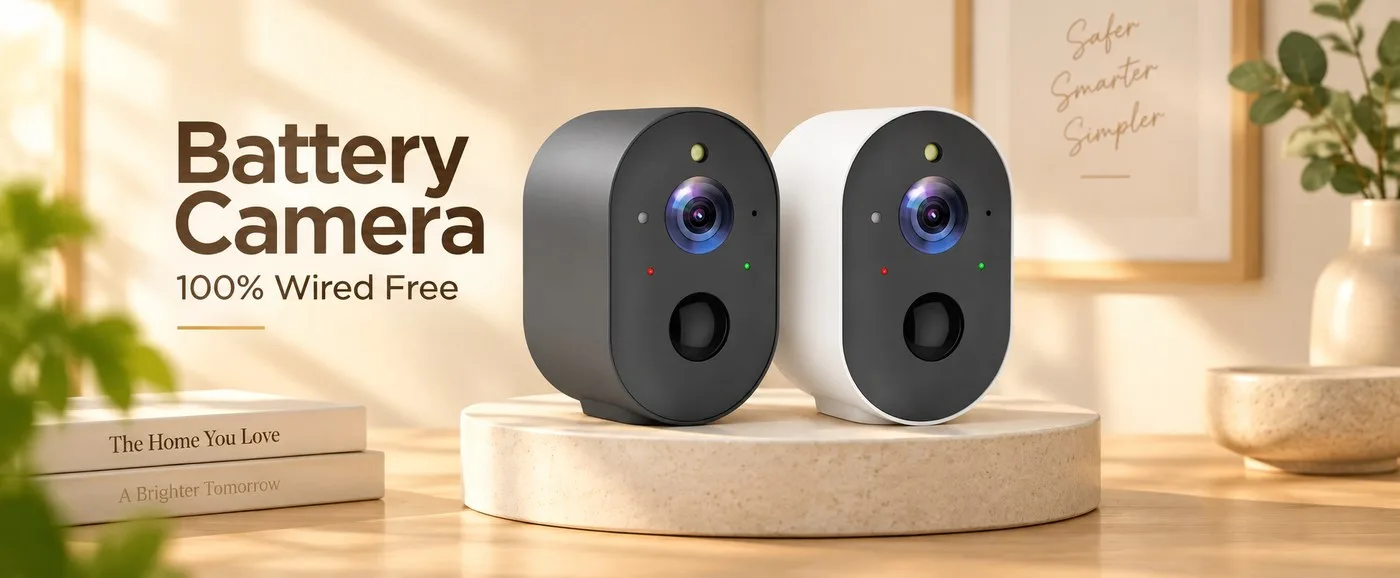
Key Points for Buyers
- Battery cameras are a power-engineering product, not an optics product
- Standby current decides satisfaction far more than resolution
- Solar pairing must use winter irradiance and real event volume
- The private-label shortlist is short: SINOVISION, Vstarcam, Sricam plus Tuya and YOOSEE ecosystem factories
- Ask for measured standby current and the event assumptions behind any battery-life claim
- "Battery camera manufacturer" is not a category you can shortlist from a catalog. Battery cameras are defined by power engineering: standby draw, wake-up time, panel pairing and who owns the app.
- Four suppliers cover most of what importers in this segment buy: SINOVISION, Vstarcam, Sricam and Tuya-ecosystem factories, each with a different trade-off.
- The spec that decides satisfaction is standby current, not megapixels — a camera drawing 0.5 W empties a small battery far sooner than the datasheet implies.
- Solar pairing is where first-time buyers lose a season: panel sizing must use winter irradiance and event volume.
- Ask for the firmware behind the app — a battery camera is a firmware product wearing a plastic shell.
1. Why battery cameras are a different sourcing problem
With a mains camera, the hard part is optics and network. With a battery camera, the hard part is power: every feature you add competes with standby time, and the customer judges the product on how often it needs charging — not on how good the image looks on day one.
That changes what you should look for in a manufacturer. The relevant skills are low-power firmware, PIR tuning, sleep/wake design and solar charging behaviour. A factory that is excellent at mains cameras can be mediocre at battery ones, and vice versa.
2. What to compare, in order
| Specification | Why it decides the outcome | What to ask for |
|---|---|---|
| Standby current | The single biggest driver of battery life claims versus reality | Measured figure in mA at idle, and the test conditions |
| Wake-up time | Determines whether the first seconds of an event are recorded | Time from PIR trigger to first frame written |
| Events per day assumption | Battery life marketing usually assumes a quiet site | The event count and clip length behind the claim |
| Solar pairing | Panel rating is meaningless without a winter figure | Recommended panel size per latitude and event load |
| Detection type | PIR, PIR plus human shape, or radar changes false alerts and power draw | Measured false-alert rate in a defined scene |
| App and account model | Decides who keeps the customer | Device registration owner, branding tiers, per-device terms |
3. Quick comparison
| # | Supplier | Base | Battery range | App | Best fit |
|---|---|---|---|---|---|
| 1 | SINOVISION publisher | Shenzhen | Battery, battery + solar, 4G solar, doorbells | Tuya, V380, ICSEE, YOOSEE | Private-label brands wanting platform choice |
| 2 | Vstarcam | Shenzhen | Wide battery and solar catalog | Own app, some Tuya | Buyers wanting one supplier for a full range |
| 3 | Sricam / Sricctv | Shenzhen (Bao'an) | Budget battery models | Own app | Price-led markets, low-volume tests |
| 4 | Tuya-ecosystem factories | Pearl River Delta | Varies by factory | Tuya / Smart Life | Smart-home integration, branded app path |
| 5 | YOOSEE ecosystem factories | Pearl River Delta | Varies by factory | YOOSEE app | Cheaper app stack, familiar to installers |
This list is short on purpose. In this segment the choice is usually which ecosystem and which factory discipline, not which brand name appears on the box.
4. The five in detail
1. SINOVISION — platform choice and low-power focus publisher
Base: Bantian, Longgang District, Shenzhen · Products: battery, battery + solar, 4G solar, dual-lens, PTZ, doorbells · App: Tuya, V380, ICSEE, YOOSEE
Manufacturing home security cameras since the brand's start in 2009 and the company's establishment in 2010, with in-house SMT and assembly in Shenzhen. The useful part for a battery-camera buyer is that the same hardware can ship on four different app ecosystems, so the platform decision can follow the market rather than the factory.
Typical configuration levers: battery capacity, panel size, detection type, housing, packaging and logo. MOQ is commonly in the hundreds per configuration, with production lead time of 20–30 days after deposit and artwork approval. Certification covers ISO 9001:2015, CE-RED, FCC (Grant ID DA2JN-SN-S3), RoHS, KC and NBTC — verified per model, as always.
Ask them: the standby current at the firmware version you will ship, and the event count behind any battery-life statement.
2. Vstarcam — breadth of battery and solar range
Base: Shenzhen · Products: indoor and outdoor battery, solar, PTZ, baby monitors, doorbells · App: own ecosystem, plus Tuya models
A long-standing Shenzhen name with an unusually wide catalog, which makes it attractive for a buyer assembling a full range from one source. Battery and solar models sit alongside mains products, and the app family is familiar to installers in several regions.
The trade-off is the usual one with a broad catalog: model-level firmware quality varies, so specify the exact SKU and test it rather than judging the range as a whole.
3. Sricam / Sricctv — value tier
Base: Bao'an District, Shenzhen · Products: budget battery and WiFi cameras · App: own app
Positioned at the value end with aggressive pricing, used by many buyers for market testing at low volume. At this price level, the buyer carries more of the quality assurance burden, and battery life claims deserve independent verification.
Appropriate when price is the primary competitive weapon and volumes are modest; less appropriate if the product must survive a two-year warranty with a low returns rate.
4. Tuya-ecosystem factories
Base: Pearl River Delta · Products: varies widely by factory · App: Tuya / Smart Life, with branded tiers
Battery cameras on the Tuya platform benefit from ecosystem integration, a mature app and a documented branded-app path. For a smart-home brand, that integration is often worth more than a small price difference.
The caution is unchanged from the mains segment: Tuya describes the software stack, not the factory. Low-power engineering still has to be evaluated per supplier.
5. YOOSEE ecosystem factories
Base: Pearl River Delta · Products: WiFi and 4G battery cameras, doorbells · App: YOOSEE app (P2P transport)
YOOSEE is the other ecosystem importers meet constantly on budget battery cameras. It is simpler and cheaper to deploy than Tuya, familiar to installers in many emerging markets, and less crowded — but the integration breadth and app customisation ceiling are lower.
As with Tuya, evaluate the factory: the platform does not determine standby current, sealing or after-sales.
5. Battery life maths buyers should do themselves
Battery life claims are usually quoted for standby only, with no events. A simple check exposes the gap:
| Input | Example | Effect |
|---|---|---|
| Battery capacity | 10,000 mAh at 3.7 V ≈ 37 Wh | Sets the energy budget |
| Standby draw | 0.5 W continuous | 12 Wh per day — one third of the battery, with no events |
| Events | 30 events × 10 s awake at 1.5 W | Adds roughly 0.6 Wh per day |
| Panel input (winter) | A 5 W panel in December at 45° north | Often under 5 Wh per day after losses |
Figures are illustrative. The point is that standby draw dominates and panel output in winter collapses — which is why "up to X days" rarely survives a real site.
6. Questions that separate a real battery supplier from a catalog
- What is the measured standby current at the shipping firmware version?
- What is the wake-up time from PIR trigger to first recorded frame?
- What event count and clip length sit behind your battery-life statement?
- Which panel size do you recommend for 45° north in December?
- What is the measured false-alert rate with animals in frame at night?
- Who owns the device account, and what are the branded-app terms?
- Which certificates cover this exact model, with dates?
- What is the RMA process and typical turnaround for a failed cell?
Frequently asked questions
Who are the main battery camera manufacturers in China?
In the private-label segment the shortlist is small: OEM factories with low-power expertise — such as SINOVISION, Vstarcam and Sricam — plus factories building on the Tuya and YOOSEE ecosystems. Global brands like Reolink and EZVIZ make battery cameras too, but they sell their own brand rather than manufacturing for others.
How long should a battery camera last on one charge?
It depends almost entirely on standby draw and event volume. A camera drawing 0.5 W with a 37 Wh battery and no solar input is doing well to last three weeks at rest, and far less with thirty events a day. Treat any "up to X months" figure as a standby-only number until the supplier states the event assumptions.
Is solar always better than a bigger battery?
No. A larger battery buys time between charges; a panel buys independence from the mains. In low-sun months a panel can contribute very little, so the correct specification is a battery sized for the worst month plus a panel that covers average consumption. Buyers who size only the panel discover the problem in the first winter.
What MOQ applies to branded battery cameras?
Commonly a few hundred units per configuration for established models with your logo and packaging, with the print run often setting the real minimum. Custom housing, custom colours and multi-language manuals raise it. Ask per configuration.
Do these manufacturers support 4G battery models?
Most do, and 4G plus solar is now the standard configuration for sites without mains. The additional questions are data plan cost, uplink quality at the mounting point and whether recording continues into local storage when the network drops.
Sourcing battery cameras?
Tell us the market, the panel conditions and the volume. We will give you the measured standby figures, the panel sizing for your latitude, and an honest answer on whether our platform options fit your channel.
Request battery camera specs →Related reading: Solar and battery sizing · PIR vs AOV detection · Top 10 manufacturers · All buying guides