
Video Doorbell OEM: How It Differs from Camera OEM (2026)
A video doorbell is not a camera with a button. Power, chime wiring, wake-up latency, detection, mounting and returns all behave differently — here is what that means for tooling, testing and first-order economics.
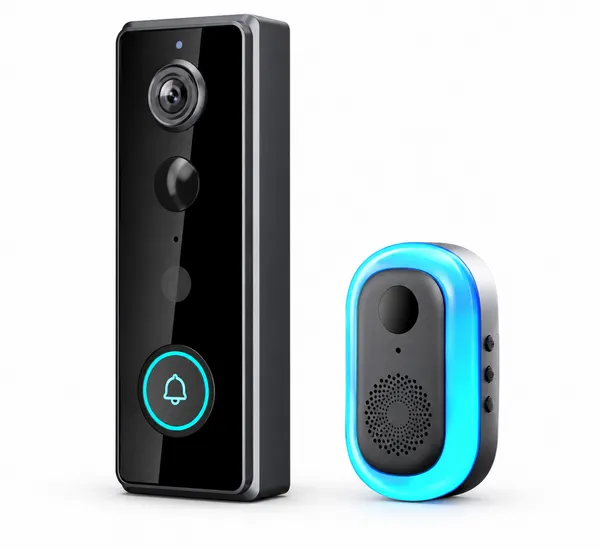
Key Points for Buyers
- A doorbell is not a camera with a button: latency, chime wiring and sealing all behave differently
- Wake-up under one second after the press is the product requirement
- Chime integration generates the majority of installation support tickets
- Doorbell tooling costs more than camera tooling because the button must move and seal
- Returns are more sensitive: buyers expect plug-and-play and judge in ten minutes
- A doorbell is a battery-powered product with a button, a chime and a visitor, not a camera with a doorbell function bolted on.
- Wake-up latency is the product. A camera can take two seconds to connect; a doorbell that takes two seconds has already lost the visitor.
- Chime integration and existing doorbell wiring are the two things that generate most after-sales tickets.
- Tooling is more complex than a camera — front panel, button mechanism, weather sealing and mounting bracket all interact.
- Returns rates behave differently. Doorbells are bought by consumers who expect plug-and-play, and judged in the first ten minutes.
Buyers often add a doorbell to a camera order assuming it is the same product with a button. It is not. The engineering overlaps; the failure modes, the tooling and the customer expectations do not. A camera that misses a motion event is annoying. A doorbell that misses a visitor is a refund.
This guide sets out where the two product lines actually differ, so the OEM decision — existing mould, modified front panel, or private tooling — is made with the real numbers in front of you.
1. The technical differences that matter
| Dimension | Security camera | Video doorbell | Why it matters |
|---|---|---|---|
| Power | Mains, PoE, solar + battery, or battery | Battery, or existing doorbell wiring (often 8–24 V AC) | Wiring varies by house and country; transformers are frequently undersized |
| Wake-up latency | 2–5 s acceptable | Under ~1 s after the press, or the visitor has walked away | Drives firmware, low-power design and server region choice |
| Detection | PIR, PIR + human shape, or radar | PIR for approach plus button press; radar increasingly used | False alerts at a door are more irritating than in a garden |
| Chime | None | Mechanical chime compatibility or a wireless chime accessory | The single largest source of installation support calls |
| Two-way audio | Optional, often unused | Core function — it is the point of the product | Echo, latency and speaker placement are product-critical |
| Mounting | Wall or ceiling bracket | Flat wall, brick, door frame; angle wedges are standard | Wrong angle means the visitor is out of frame |
| Weather rating | IP65/IP66 typical for outdoor | Faces rain directly; exposed to sun on one side | Sealing around the button is the weak point |
| Size constraint | Flexible | Must fit a door frame, next to a handle, above a lock | Limits battery volume and therefore standby time |
2. Chime integration: where the support tickets come from
A camera has one installation step. A doorbell has three: mount, power, and make the chime work. The third one is where installers and consumers both get stuck.
| Scenario | What is required | Common failure |
|---|---|---|
| Replace an existing wired doorbell | Compatible transformer voltage; bypass or keep the mechanical chime depending on design | Transformer too weak; chime hums or does not ring |
| No existing wiring | Battery doorbell plus a wireless chime plugged indoors | Chime and doorbell not paired at the factory or lost after reset |
| Apartment with an intercom | Usually no integration possible | Buyer expectation set by marketing, not by the product |
| Multiple chimes | Several wireless chimes on one doorbell | Range through concrete walls overestimated |
Ask your supplier which of these scenarios the model supports in writing, and in which markets the transformer assumption holds. A doorbell designed around North American 16 V AC transformers behaves differently in a European home.
3. Tooling: why a doorbell mould costs more than a camera mould
- More moving parts in one small space. Front panel, button mechanism, lens window, PIR window, speaker grille, microphone port and sealing all compete for the same face.
- The button is a mechanical component. Travel, feel, dust ingress and water sealing must be designed together; a camera has no equivalent.
- Sealing is harder. A camera can be sealed as a closed box. A doorbell has a button that must move and a lens that must see.
- Thermal load. Direct sun on a dark front panel plus a small enclosure plus continuous PIR duty is a real constraint.
- Angle wedges. Most doorbells ship with 15–30° wedges; these are separate small moulds or a machined part.
4. Three OEM paths, and what each costs you
| Path | What changes | Tooling | Best for |
|---|---|---|---|
| Existing mould, your brand | Colour, logo, packaging, app branding | None (sometimes a pad-print plate) | Fast launch, testing the market |
| Modified front panel | New face design on the existing chassis | One insert or a single cavity tool | Brands that want a distinct look without full tooling |
| Full private mould | Complete industrial design | Multiple tools: housing, button, bracket, wedge | Brands committing to a multi-year product line |
Most first-time doorbell buyers start at path 1 or 2. Full private tooling makes sense once the category is proven in your channel.
5. Testing: the checks that differ from a camera
- Press-to-notification timing measured on a real phone on a real mobile network, not office Wi-Fi.
- Chime pairing repeated after a factory reset, a Wi-Fi change and a power cut.
- Two-way audio at both ends: echo, volume, and intelligibility with traffic noise.
- Wired install simulation at the lowest transformer voltage you claim to support.
- Sealing around the button after repeated presses — the wear point cameras do not have.
- Battery life with realistic visitor and motion event counts, not standby only.
- Angle coverage with the supplied wedge, at the mounting height customers actually use.
6. Commercial differences
| Item | Camera | Doorbell |
|---|---|---|
| Typical buyer | Distributor, installer, brand | Same, plus consumer retail and e-commerce sellers |
| Returns sensitivity | Moderate | High — sold on install simplicity |
| Packaging richness | Standard retail box | Higher: chime, wedge, screws, quick-start card |
| Support load | Setup and firmware | Setup, chime, wiring, audio quality |
| Certification | CE/FCC/RoHS as applicable | Same, with attention to the radio module and any wired input |
Frequently asked questions
Can I sell a battery doorbell where homes already have wired doorbells?
Yes, but be explicit about what happens to the existing chime. Some battery doorbells support the old mechanical chime through a small module; others ignore it entirely and rely on a wireless plug-in chime. Say which, on the box, or expect returns.
Is a doorbell harder to certify than a camera?
The radio certification work is the same. The extra attention goes to any wired input and to the audio path, and to documenting what the device does when connected to an external chime. Confirm the exact model variant with your supplier before booking a test lab slot.
What MOQ should I expect for a branded doorbell?
It depends on the path: existing mould with a logo and packaging is usually governed by the packaging print run; a modified front panel adds a tooling and sampling step; a full private mould is a project with its own schedule. Ask for the MOQ per path in writing — they are not the same number.
Why do doorbells drain batteries faster than cameras in the same product family?
PIR has to run continuously at a door where people approach constantly, and the wake-up requirement is stricter, so the device spends less time in its deepest sleep state. Marketing claims for standby time rarely survive a busy entrance.
Can the doorbell share the same app as my camera range?
Usually yes, and that is a strong selling point — one app, one account, one support path. Confirm the platform supports doorbell events (press, visitor, chime) as first-class notifications rather than as a generic motion event.
Adding a doorbell to your camera range?
Tell us your channel, the markets you sell into, and whether you need existing mould, modified front panel or private tooling. We will come back with the real MOQ, tooling scope and test plan for each path.
Compare doorbell OEM paths →Related reading: OEM vs ODM vs white label · Private mould tooling cost · Packaging checklist · All buying guides