
PTZ vs Fixed Cameras: Coverage per Dollar on Commercial Sites (2026)
How many fixed cameras it takes to match one PTZ, what PTZ loses while moving, and a site-by-site decision table for mixed commercial deployments.

Key Points for Buyers
- A PTZ gives one view at a time; fixed cameras never look away
- Compare cost per covered point including mounts, PoE and channels
- Four fixed wide cameras cover 360 degrees; one PTZ covers it sequentially
- PTZ tracking is reactive and leaves blind time while moving
- Most commercial sites need fixed at evidence points plus PTZ on open areas
- A PTZ gives one view at a time — but that view can be anywhere. Coverage and simultaneity are different products.
- Compare total cost per covered point, not price per camera: mounts, cabling, install labour and switches count.
- Fixed cameras never look away. For an entrance or a shutter door, that matters more than range.
- PTZ pays where the area is large and someone reacts to alerts. Without a responder, you get footage of an empty yard.
- Most commercial sites want both: fixed for evidence points, PTZ for the open area.
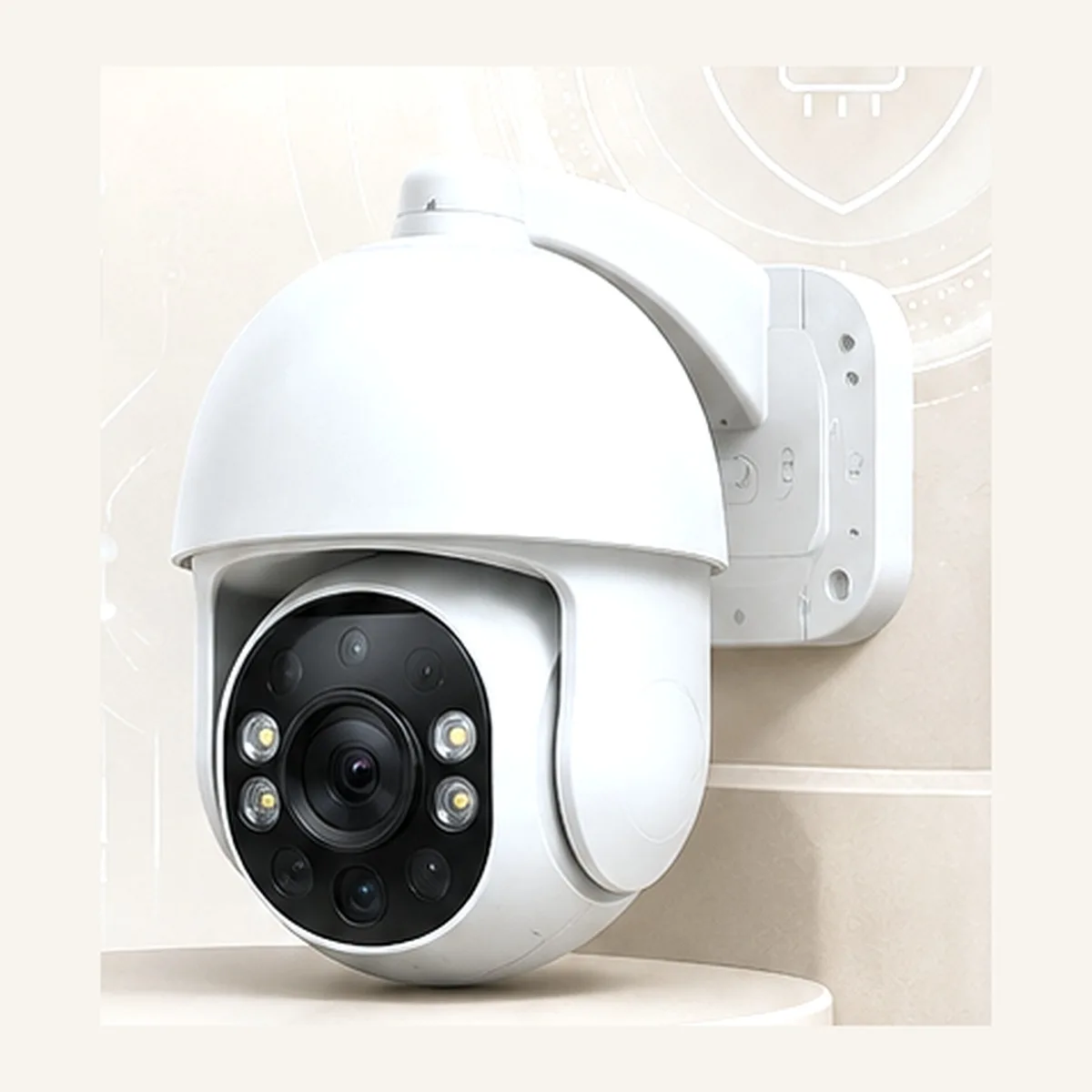
The PTZ argument is easy to make on a spec sheet: one camera, 355° of pan, 90° of tilt, 10× zoom, fewer devices to buy. The counter-argument never appears on the sheet: while the camera is looking left, the right side is unrecorded.
This guide gives importers and integrators a way to compare the two honestly, and a decision table for mixed sites.
1. Two different coverage models
| Property | Fixed camera | PTZ camera |
|---|---|---|
| Coverage over time | One cone, permanently | Whole area, sequentially |
| Simultaneity | Yes — every point always watched | No — one view at a time |
| Cost driver | Number of points | Area size and zoom requirement |
| Failure mode | Lens or sensor | Motor, belt, or preset drift |
| Maintenance | Clean the dome | Clean plus mechanical wear, often outdoors |
| Power | Low, constant | Higher during movement and zoom |
| Bandwidth | Constant | Spikes when zooming and tracking |
Table 1 — The trade is coverage-in-parallel against coverage-in-sequence.
2. The coverage math
A rough model: a 2.8 mm fixed lens gives around 100° horizontal. To cover 360° without gaps you need four cameras. A PTZ covers the same circle with one device, one at a time.
| Area to cover | Fixed cameras needed | PTZ units | Notes |
|---|---|---|---|
| Single entrance | 1 | 1 (overkill) | Fixed wins on cost and reliability |
| Shop interior, 100 m² | 2–3 | 1–2 | Fixed for the till, PTZ optional |
| Yard, 50 × 40 m | 4–6 | 1–2 | PTZ wins on cabling, loses on simultaneity |
| Warehouse aisle row | 1 per aisle | 1 covering several | PTZ only if a person drives it |
| Perimeter, 200 m | 8–12 | 2–3 plus fixed | Fixed at gates, PTZ on the fence line |
Table 2 — Illustrative geometry. Real numbers depend on lens, mount height and the detail you need at the far edge.
3. What PTZ loses, and when it does not matter
Blind time while moving
While a PTZ travels between presets, everything it passes and everything behind it goes unrecorded. In a manned control room with an operator reacting to events, that is acceptable. In an unmanned site reviewed after an incident, the missing seconds are the ones you needed.
Tracking is reactive
Auto-tracking follows what it has already detected. By the time it turns, the intruder has moved, and the rest of the yard is now unobserved.
Mechanical wear outdoors
Motors, belts and slip rings age. A PTZ that runs hundreds of preset tours a day will need service sooner than a fixed dome — plan the maintenance and spare-part access before quoting a multi-year contract.
4. Decision table by site
| Site | Recommendation | Reason |
|---|---|---|
| Retail till and entrance | Fixed, both points | Evidence value requires continuous coverage |
| Open yard with a guard | PTZ plus one fixed overview | Operator can drive the PTZ; overview protects the gap |
| Unmanned car park | Fixed at entries, PTZ optional | No responder means tracking adds little |
| Loading bay | Fixed on the dock edge | Repeated identical framing aids review |
| Long fence line | Fixed at gates, PTZ on the run | Mixed: evidence plus reach |
| Construction site | PTZ plus battery fixed units | Layout changes; some points have no power |
Table 3 — Most commercial sites are mixed. Quoting all-fixed or all-PTZ usually overprices one requirement.
5. What to verify before committing
- Preset accuracy over a week. Does the camera return to the same position, or drift?
- Zoom in low light. Long zoom on a small sensor gives a bright but noisy image; test at the distances you quote.
- Speed versus image quality. Fast panning produces motion blur; ask for the pan speed at which the image is still usable.
- Power and PoE budget. Pan, tilt and zoom together draw more than the idle figure.
- Weather sealing on the moving parts. The mechanical joint is the first thing to fail outdoors.
- Recording fallback. If the PTZ is mid-tour, is anything else recording that area?
Frequently asked questions
Is one PTZ cheaper than four fixed cameras?
Usually on hardware and cabling, sometimes not on total cost of ownership once maintenance and coverage gaps are counted. Compare cost per covered point at the detail level you actually need, and include mounts, PoE ports and recording channels.
Can a PTZ replace fixed cameras entirely?
On a site with an operator watching alerts, often yes for the open areas. For entrances and evidence points, fixed cameras remain the better choice because they never look away.
Do PTZ cameras wear out?
They have moving parts, so yes — motors and belts are consumables on a long enough horizon. Ask for the rated movement cycles and whether the pan motor is serviceable in the field.
How much zoom do I actually need?
Work backwards from the plate or face size you must resolve at the far edge of the area, then pick the focal length. Zoom without enough sensor and light gives magnification without information.
What is the most cost-effective commercial layout?
Fixed cameras at every evidence point (doors, tills, gates, dock edges), plus one or two PTZ units for the large open areas. That combination usually beats either extreme on both cost and coverage.
Planning a commercial layout?
Send us a site sketch with the points you must cover and the distances involved. We will return a camera count using fixed and PTZ units, with the coverage gaps marked rather than hidden.
Get a layout review →Related reading: Dual-lens vs single-lens · 4G data plans · PTZ cameras · All buying guides