
How Distributors Evaluate 4G Solar Security Cameras Before Placing a Bulk Order
Before committing capital to volume procurement of 4G solar security cameras, commercial distributors systematically evaluate solar conversion efficiency, cellular module certifications, battery chemistry safety, and false-alarm suppression to minimize costly RMA rates.
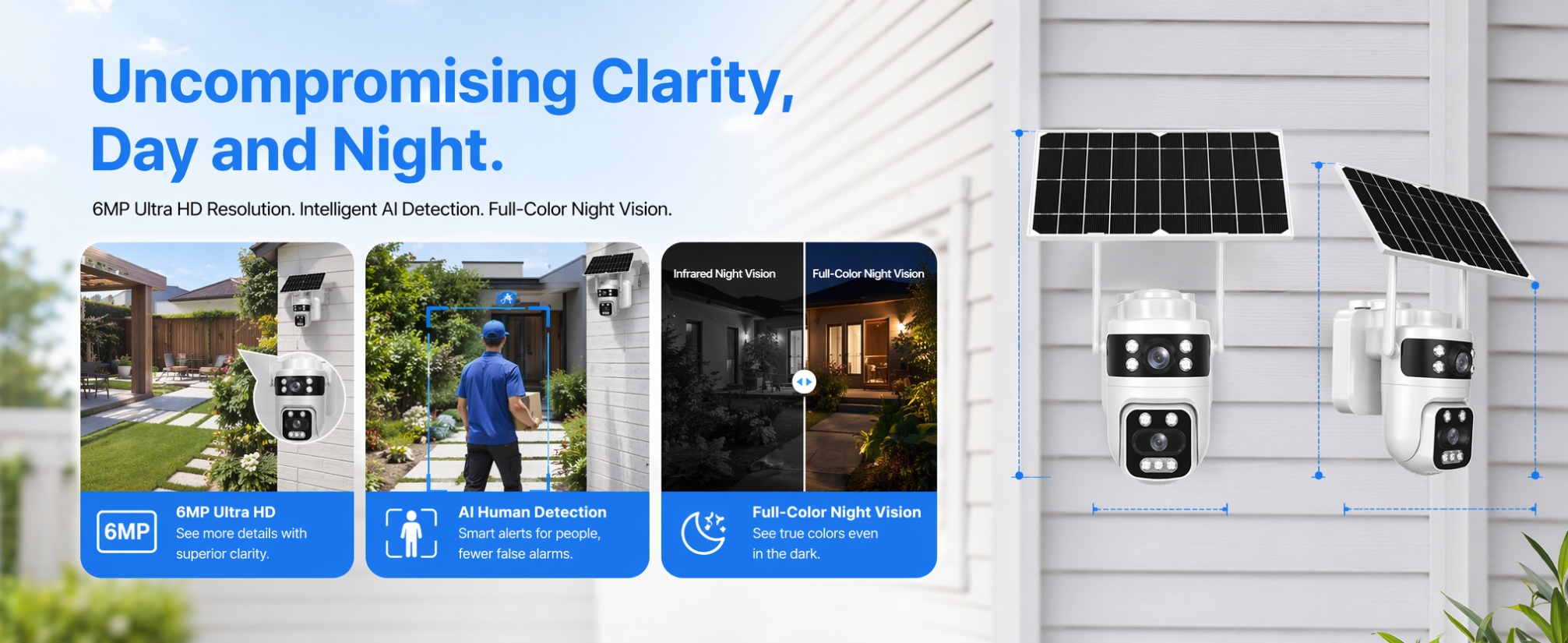
The surge in demand for perimeter surveillance across off-grid construction sites, agricultural acreage, oil fields, and critical infrastructure has positioned 4G solar-powered security cameras as one of the fastest-growing categories in physical security distribution. However, unlike standard PoE or Wi-Fi cameras, 4G solar systems present complex operational interdependencies between photovoltaic generation, energy storage chemistry, low-power microcontrollers, and carrier-grade cellular radio connectivity. For security distributors and B2B wholesalers, committing to a bulk purchase order requires a rigorous multi-vector technical evaluation to prevent post-deployment RMA fallout and protect channel margins.
1. Power Autonomy & Battery Chemistry Resilience A distributor's first due-diligence checkpoint is rainy-day autonomy. Quality commercial units utilize Lithium Iron Phosphate (LiFePO4) cells rather than conventional Ternary Lithium (NMC) due to superior thermal stability, extended cycle life (2,000+ full cycles versus ~500), and safer behavior under extreme ambient temperatures (-20°C to 60°C). Distributors scrutinize solar panel wattage-to-battery capacity ratios, verifying whether the panel can sustain continuous PIR standby and daily event clips across five consecutive overcast winter days.
2. Cellular Module Certification & Multi-Carrier Band Support Cellular interoperability failures remain the leading cause of wholesale returns. B2B distributors require verified carrier certifications (PTCRB, AT&T, Verizon, T-Mobile for North America; CE/RED for Europe) and global Quectel or Fibocom LTE Cat-1 or Cat-4 modules. The firmware must support automated APN provisioning, failover reconnections, and nano-SIM/eSIM flexibility so end-customers avoid manual on-site troubleshooting.
3. PIR Motion Detection & Dual-Radar False-Alarm Filtering Continuous streaming over LTE quickly exhausts cellular data packages and battery banks. Reliable field operation hinges on micro-power dual-sensing: combining ultra-low-power passive infrared (PIR) with 24GHz mmWave radar or edge-AI person/vehicle classification. This prevents costly false triggers caused by vegetation sway, rain, or thermal air currents while preserving standby currents below 2.5mA.
4. Firmware Stability, Storage Protocols, and Cloud/NVR Handshake Tier-1 distributors evaluate whether cameras support standard RTSP/ONVIF streams over 4G VPN tunnels or direct AWS/Azure S3 event archiving alongside local encrypted MicroSD storage (up to 256GB). A dependable watchdog circuit that automatically power-cycles the camera if cellular signal is lost for more than two hours is essential for remote deployments.
5. Manufacturer Warranty, Ingress Protection, and RMA Support Finally, distributors examine ingress protection ratings (IP66 or IP67 certified with waterproof seal testing) and supplier warranty terms. Top-tier manufacturers back their hardware with a minimum 2-year advance-replacement warranty and provide localized spare part modules for field maintenance.